
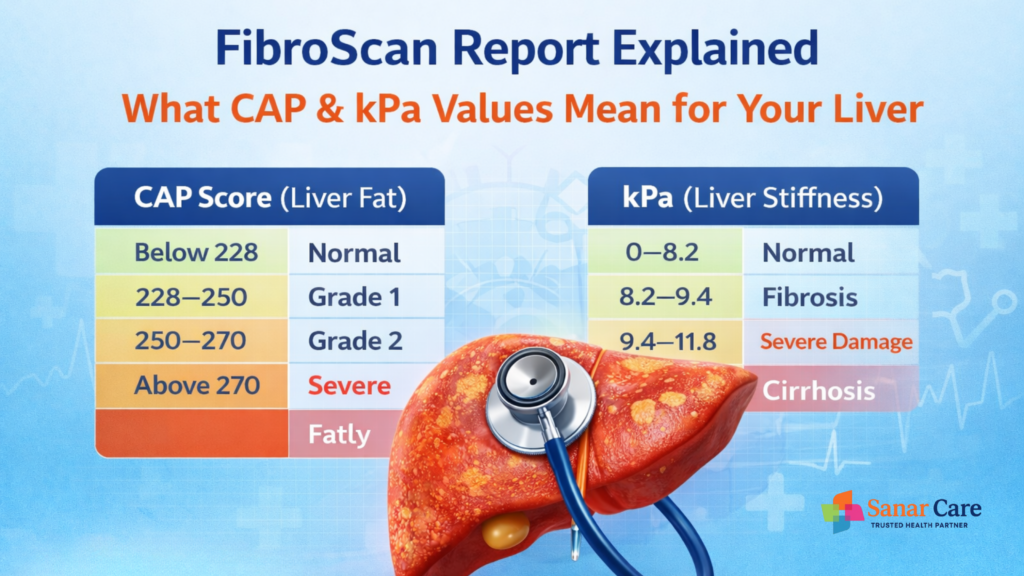
In any FibroScan report that you receive, you will find two significant values:
👉 CAP score
👉 kPa (kilopascal) value
For most patients, this is where they get stuck…
Let me explain everything in the easiest way possible.
What Is a FibroScan Test?
FibroScan is a fast, non-invasive procedure that evaluates your liver’s condition.
It will provide you with two important details:
The quantity of fat in your liver
The stiffness (damage) of your liver
And the best thing about it?
It’s done without any needles, causing no pain and takes only a few minutes to complete.
What Is CAP Score? (Liver Fat Measurement)
CAP is an acronym for Controlled Attenuation Parameter.
In simple terms:
It helps to determine the amount of fat accumulated in your liver.
Interpretation of CAP Scores:
Less than 228 = Healthy liver (without any fatty degeneration)
228 – 250 = Mild fatty liver (Grade 1)
250 – 270 = Moderate fatty liver (Grade 2)
More than 270 = Severe fatty liver (Grade 3)
It is popularly referred to as Fatty Liver Disease.
The greater the CAP score, the higher the level of fat accumulation.
What Is kPa? (Liver Stiffness Measurement)
kPa (kilopascal) is an indicator of the stiffness or hardness of your liver.
Why is this important?
Because as liver damage progresses, its stiffness also rises.
Understanding kPa Values:
Below 8.2 kPa: Liver is healthy and normal
Between 8.2 to 9.4 kPa: Liver shows early signs of damage or fibrosis
Between 9.4 to 11.8 kPa: Liver shows considerable damage
Over 11.8 kPa: High chance of developing cirrhosis
More kPa = Higher Stiffness = More Damage
Why Both CAP & kPa Matter
This is where most individuals commit an error:
Concentrating only on one of these numbers.
Both of these factors determine how healthy your liver really is.
CAP tells us about the amount of fat present
kPa informs about the extent of damage
You can be fat without any significant damage
You can even be damaged without being fat
What Happens If Values Are High?
If your CAP or kPa values are elevated, it may indicate:
- Fat buildup in the liver
- Early-stage liver damage
- Risk of fibrosis or cirrhosis
Ignoring these signs can lead to serious complications over time.
Can You Improve Your FibroScan Results?
Absolutely – particularly when caught early.
Little adjustments go a long way:
Reduce oily foods
Decrease sugar consumption
Get enough exercise
Keep your body weight within the healthy range
Early intervention is key for reversing fatty liver disease.
When Should You Get a FibroScan?
You should take this exam if:
You have an unbalanced diet
You do not work out
You spend a lot of time sitting
You have visceral fat or obesity
You wish to have a general health screening
Closing Remarks
FibroScan results are fairly simple; all you need to know is that:
👉 CAP = Liver fat
👉 kPa = Liver injury
Do not disregard these figures.
Since liver ailments tend to develop without warning, and when signs and symptoms begin to surface, the situation might already be dire.
If you prioritize your well-being:
Do not assume. Take the test.
A non-invasive procedure right now might save you from significant complications down the road.