Blogs

Blogs

FibroScan Report Explained: What CAP & kPa Values Mean for Your Liver

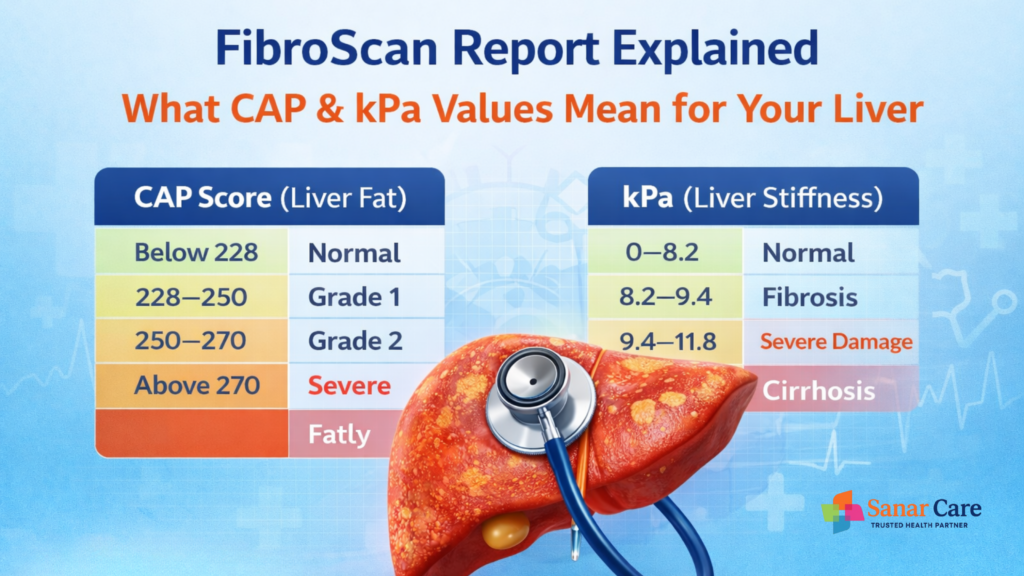
In any FibroScan report that you receive, you will find two significant values: 👉 CAP score👉 kPa (kilopascal) value For most patients, this is where they get stuck… Let me explain everything in the easiest way possible. What Is a FibroScan Test? FibroScan is a fast, non-invasive procedure that evaluates your liver’s condition. It will provide you with two important details: The quantity of fat in your liverThe stiffness (damage) of your liver And the best thing about it? It’s done without any needles, causing no pain and takes only a few minutes to complete. What Is CAP Score? (Liver Fat Measurement) CAP is an acronym for Controlled Attenuation Parameter. In simple terms:It helps to determine the amount of fat accumulated in your liver. Interpretation of CAP Scores:Less than 228 = Healthy liver (without any fatty degeneration)228 – 250 = Mild fatty liver (Grade 1)250 – 270 = Moderate fatty liver (Grade 2)More than 270 = Severe fatty liver (Grade 3) It is popularly referred to as Fatty Liver Disease. The greater the CAP score, the higher the level of fat accumulation. What Is kPa? (Liver Stiffness Measurement) kPa (kilopascal) is an indicator of the stiffness or hardness of your liver. Why is this important? Because as liver damage progresses, its stiffness also rises. Understanding kPa Values: Below 8.2 kPa: Liver is healthy and normalBetween 8.2 to 9.4 kPa: Liver shows early signs of damage or fibrosisBetween 9.4 to 11.8 kPa: Liver shows considerable damageOver 11.8 kPa: High chance of developing cirrhosis More kPa = Higher Stiffness = More Damage Why Both CAP & kPa Matter This is where most individuals commit an error: Concentrating only on one of these numbers. Both of these factors determine how healthy your liver really is. CAP tells us about the amount of fat presentkPa informs about the extent of damage You can be fat without any significant damageYou can even be damaged without being fat What Happens If Values Are High? If your CAP or kPa values are elevated, it may indicate: Ignoring these signs can lead to serious complications over time. Can You Improve Your FibroScan Results? Absolutely – particularly when caught early. Little adjustments go a long way: Reduce oily foodsDecrease sugar consumptionGet enough exerciseKeep your body weight within the healthy range Early intervention is key for reversing fatty liver disease. When Should You Get a FibroScan? You should take this exam if: You have an unbalanced dietYou do not work outYou spend a lot of time sittingYou have visceral fat or obesityYou wish to have a general health screening Closing Remarks FibroScan results are fairly simple; all you need to know is that: 👉 CAP = Liver fat👉 kPa = Liver injury Do not disregard these figures. Since liver ailments tend to develop without warning, and when signs and symptoms begin to surface, the situation might already be dire. If you prioritize your well-being: Do not assume. Take the test. A non-invasive procedure right now might save you from significant complications down the road.

Blogs

Alcohol-Free but Still at Risk? How Your Liver Can Be Damaged Without Drinking

Alcohol-Free but Still at Risk? How Your Liver Can Be Damaged Without Drinking What most people think is: “Since I don’t take alcohol, my liver is fine.” However, this isn’t true anymore. A lot of people who have never had alcohol in their lives end up with liver issues. The reason behind this isn’t alcohol but your lifestyle. Why Liver Damage Is Increasing in Non-Drinkers Liver health is not only linked to alcohol anymore. Your lifestyle choices are the major factors to consider nowadays. Here is what silently harms your liver: Although this list might seem ordinary, after some time you will start experiencing changes in your liver’s functioning. What Is Fatty Liver Disease? The term for excess fat accumulation in the liver is called Fatty Liver Disease. This disease is now highly prevalent, particularly among urbanites. There are two forms: The latter form is what the majority of us are suffering from. The Silent Danger: No Early Symptoms One of the greatest dangers of fatty liver disease is its stealthy development. During the initial phase, You could be feeling totally fine even as fat builds up inside your liver. Once you start experiencing symptoms such as exhaustion, pain, or digestive problems, it may already be too late. What Happens If You Ignore It? Neglecting fatty liver disease will result in severe consequences like the following: Delaying treatment will make reversing fatty liver even more difficult. Early Detection Is the Only Smart Move Here’s the truth most people avoid: You cannot rely on symptoms to detect liver problems early. The only way to stay safe is through early testing. FibroScan: A Simple and Painless Liver Test One of the most advanced and effective methods of assessing the condition of the liver is the FibroScan. FibroScan is particularly relevant in diagnosing fatty liver disease. Who Should Consider a Liver Test? You should not wait for symptoms if your lifestyle includes: Even if you don’t drink alcohol, these factors still put you at risk. Can Fatty Liver Be Reversed? Yes, but only if caught early on. Here are some easy ways to manage diabetes: However, if diabetes is left untreated, it becomes harder to treat. Final Thoughts: Don’t Rely on Assumptions This mindset may put you at risk for something much more serious. Your liver condition will depend more on your everyday routine than drinking. It’s always better to take action while you still can when your health is even remotely questionable. This quick test now could save you from something much worse down the road. Fibro Scan

Blogs

Why am I feeling pain in my lower abdomen? Reasons, Signs and When to Be Tested.

Lower abdominal pain is something that most people do not pay attention to, until it becomes a problem. The fact of the matter is that pain in the lower abdomen can result from a variety of factors, from something as minor as a problem with digestion to something as serious as a medical problem. The truth of the matter is that if you are feeling discomfort, your body is trying to tell you something. Common Causes of Lower Abdominal Pain Pain in the lower abdomen can be caused by a number of factors depending on your age, lifestyle, and gender. These are the common causes of lower abdominal pain but may be temporary. Urinary tract infections are common. Diagnosis is done using a urine test. This is a medical emergency and needs immediate attention. Diagnosis is done using an ultrasound or CT scan. When Should You Worry? You should NOT ignore lower abdominal pain if: Ignoring these signs may delay the diagnosis of underlying conditions. How Is Lower Abdominal Pain Diagnosed? This is where people go wrong. They self-diagnose. Proper diagnosis is done with proper tests: With advanced technology at hand, patients at Sanar Care Diagnostic Centre get same-day appointments with quick reports. Why Sanar Care Diagnostic Centre Gurgaon? Come on, let’s be honest with each other. Everyone claims to deliver accurate results. What matters, however, is: ✔️ Same-day appointment booking✔️ Fast and reliable results✔️ Expert radiologists✔️ State-of-the-art equipment (Ultrasound, CT, MRI, FibroScan)✔️ Multiple locations across Gurgaon 👉 You’re taking a risk with your health by delaying tests. Can Lower Abdominal Pain Be Prevented? The simple answer is: yes, it can be prevented in many ways: Book Your Test Today (Don’t Delay) Lower abdominal pain is not a very severe health issue, but it can lead to severe health problems if not treated at the right time. Early detection of health problems means quick recovery and reduced risks. Call us WhastApp

Blogs

Liver Function Test: Why Your Doctor May Recommend It

Liver Function Test: Why Your Doctor May Recommend It Introduction A Blood Test for liver function is the best way to see how your liver is doing. We see that most liver related issues present very subtly which is why many ignore early signs until the issue becomes more apparent. Factors like a fatty diet, alcohol use, long term meds and stress play a role in wearing out the liver over time. Also, because it is so common for symptoms to go unnoticed, we at which point do a Liver Test when certain issues come up or during routine health checks. You can find in depth liver research at the Indian Council of Medical Research website:. https: Http:/www.icmr.gov.in/. Why do we do the Liver Function Test? Your liver performs vital body functions like detoxification, digestion support, metabolism and nutrient absorption. When these functions are affected by something, your body begins to show early signs. A timely Liver Function Test will find out issues like inflammation, fatty liver, enzyme imbalance and early infections. With clean test results, doctors are able to recommend appropriate lifestyle changes or treatment which helps to avoid the condition from becoming serious. Persistent Fatigue Continuous fatigue is a symptom which may present when the liver has trouble with nutrient absorption or toxic material removal. Also this is a hard one to notice as it which is very similar to ordinary tiredness. Yellow Skin or Eyes Jaundice is a result of increased bilirubin levels. This is a sign of liver stress which must be confirmed with a Liver Function Test. Abdominal Discomfort Upper abdominal pain, distention and heaviness after meals is a sign of liver irritation or inflamation. In fatty liver we see this very often. Sudden Appetite Loss When liver cells are inflamed digestion slows which in turn causes reduced appetite and unexpected weight change. Changes in Urine or Stool Dark colored and frothy urine or pale stool may present with enzyme imbalance. A Liver Function Test quickly will reveal the exact cause. Itchy Skin High levels of bile in the blood cause skin irritation, dryness and itchiness which is a sign of liver stress. Which of these should get a liver test regularly. Individuals with diabetesPeople with fatty liverAdults who consume alcohol frequentlyPeople who have a family history of liver disease.Individuals with high cholesterolPeople taking long-term medicationAnyone recovering from hepatitis infections1 What the Liver Test Measures A Blood test for the liver usually includes ALT, AST, Alkaline Phosphatase, Bilirubin, GGT, Total Protein and Albumin. These are the markers which doctors use to determine liver inflammation, enzyme action and overall function. Getting tested regularly helps you see improvements if you are in a health improvement plan or on a medical treatment. Why delay a liver test? Liver disease often develops gradually with symptoms presenting at later stages of the illness. With early detection we see reduced risk of developing issues like fibrosis, fatty liver, or cirrhosis. Also that it is a quick, easy and cheap procedure what doctors put forth which is to include it in routine health check ups also when symptoms present themselves at any time. Conclusion Taking care of your liver is very important for long term health. Signs like fatigue, jaundice, loss of appetite, itching or abdominal pain should not be dismissed. We get the Liver Function Tests done which help in at an early stage in identifying problems that will in turn bring about faster treatment and better recovery. Book in for your test at Sanar Care Diagnostic Centre: www.sanarcarediagnosticcentre.com

Blogs

Kidney Function Test (KFT): Symptoms That Indicate You Need It

Kidney Function Test: Symptoms That Indicate You Need It Introduction A Kidney Function Test will help doctors assess how effectively your kidneys filter waste, regulate the amount of fluid in the body, and control the levels of minerals. Kidney failure is often asymptomatic during its early stages, so many individuals ignore the signs of kidney failure until it becomes severe. In addition, modern-day factors (e.g., dehydration, excessive salt consumption, uncontrolled diabetes, and extended work hours) increase the amount of strain that kidneys undergo. Therefore, Timely detection (via a Kidney Test) and treatment of mild symptoms so that worsening injury does not occur are critical to long-Term Health. You can also explore advanced kidney health information on the Indian Council of Medical Research website:https://www.icmr.gov.in/ Why the Kidney Function Test Matters The kidneys filter toxins, regulate blood pressure and maintain an electrolyte balance. There are several important functions that the kidneys have. The initial signs of kidney weakness can take a while to develop. Early detection through a kidney test (aka urinalysis) can relieve the long-term consequences of diseases like chronic kidney disease and kidney failure. Due to the ease of administration, speed and accuracy of the test, many health practitioners suggest performing a routine health screen that includes this type of test. Symptoms That Indicate You Need a Kidney Function Test 1. Persistent Fatigue and Weakness When you supposedly “rest” but still feel fatigued, it’s likely that your kidneys are not efficiently filtering waste out of your bloodstream. Accumulation of toxins diminishes energy output within you. This symptom is frequently disregarded, as many people associate it with normal feelings of fatigue. 2. Swelling in Feet, Ankles or Face The kidneys are responsible for regulating fluid levels in the body. When they do not work properly, they are unable to remove excess fluid from the body, resulting in fluid build-up in body tissues (i.e., swelling) of the legs, ankles, hands, or under the eyes. Do not ignore early signs of swelling; this is a warning that your body may be retaining an abnormally high amount of fluid. 3. Frequent Urination or Reduced Urine Output High frequency of urination and lack of liquid being flushed from the bladder can be a cause for concern regarding kidney issues. However, the presence of foam or dark yellow urine can signal increased11998 or kidney disease or other urinary tract imbalances due to decreased filtration capacity of the kidneys. 4. High Blood Pressure High blood pressure frequently occurs due to improper control of blood flow through the kidneys. Furthermore, hypertension causes additional injury to the kidneys, establishing a vicious cycle of injury. Therefore, high blood pressure patients are usually advised to undergo a kidney test. 5. Lower Back Pain (Side or Flank Pain) If you have pain on one or both of your sides that is located in your lower back, then this is likely due to inflammation/infection/blockage in a kidney. When comparing kidney pain to regular back pain, you will likely feel deep, sharp, and more severe kidney pain than typical back pain. 6. Loss of Appetite, Nausea or Vomiting When kidneys don’t do their job of filtering out toxic substances, those toxic substances build-up in your system and can have a negative impact on your gut. For example, nausea and vomiting are common symptoms that many people experience because of this build-up, as well as a decrease in appetite suddenly. 7. Dry, Itchy Skin The kidneys also help control the levels of minerals and nutrients in our bodies. When the kidneys grow weak and fail to regulate these minerals, one will experience dry, itchy and irritated skin, which is likely the first symptom of early kidney dysfunction. 8. Difficulty Concentrating or Feeling Confused Excessive levels of toxins in the bloodstream disrupt the brain’s ability to concentrate and causes mental fatigue. This effect will become much more pronounced as the kidneys continue to tire. Who Should Consider a Kidney Function Test Regularly? What the Kidney Function Test Measures A standard Kidney Function Test includes: These parameters help doctors understand overall kidney performance and detect early signs of damage. Why You Should Not Delay a Kidney Function Test Kidney disease typically does not appear until significant damage has been done to the kidney over time. Early tests can detect kidney disease before the development of advanced stages requiring treatment such as dialysis or permanent complications. A Kidney Function Test is very affordable and can be performed without discomfort in most cases; therefore, people are encouraged to have a Kidney Function Test as a part of routine health care. Conclusion A Kidney Function Test becomes essential when you notice symptoms such as swelling, fatigue, urine changes, high BP or lower back pain. Because early detection protects long-term health, getting a simple Kidney Function Test can prevent serious kidney complications. You can book your test at Sanar Care Diagnostic Centre here:https://sanarcarediagnosticcentre.com/contact-us/ For more medical safety guidelines, you can also visit the FDA:https://www.fda.gov/medical-devices

Blogs

Ultrasound Scans: Types, Uses, Preparation and Benefits

Ultrasound Scans: Types, Uses, Preparation and Benefits Introduction Ultrasound scans are utilised by a variety of physicians due to their ability to produce detailed images of the inside of the body without exposing the patient to radiation. Physicians utilise an ultrasound scan to view the current state of organs, tissues, and blood flow; therefore, ultrasound scans provide a safer diagnostic procedure than other imaging techniques for pregnant females, children, and older patients. As medical technology continues to improve, physicians are utilising ultrasound scans more frequently to find medical problems in their patients before they become serious, direct future medical treatment for a patient, and track the patient’s medical status over time. More detailed imaging guidelines may be accessed via the Indian Council of Medical Research website: https://www.icmr.gov.in/. What Are Ultrasound Scans? An ultrasound scan uses soundwaves above the range of human hearing, called ultrasound, to create images of body parts. A trained technician, or sonographer, positions a transducer on the patient’s skin and emits ultrasound signals into the body. The emitted soundwaves return to the transducer as echoes, which an ultrasound machine processes into an image that can be viewed on a computer monitor. Medical professionals typically prefer using ultrasound rather than other types of imaging (e.g., X-rays) for diagnosing conditions early in life due to the absence of radiation exposure. Using ultrasound, medical professionals can identify the cause of abdominal discomfort, locate gallstones, monitor the development of an unborn child, perform thyroid evaluations, and inspect various other types of soft tissue. Because ultrasounds allow medical professionals to see subtle changes in tissues before they become severe, they allow them to treat issues sooner than they would otherwise treat them. Types of Ultrasound Scans Abdominal Ultrasound Doctors use abdominal ultrasound to examine the liver, gallbladder, pancreas, spleen, and kidneys. They use this test to identify things like gallstones, inflammation, infection, kidney stones, and any liver problems. When patients say they are in pain or feel discomfort in their belly for a long time, doctors can find out what is causing the problem quickly by using an abdominal ultrasound scan. An abdominal ultrasound scan gives physicians clear information about an abdominal condition, allowing physicians to determine the appropriate course of treatment without delay parenthetical. Pelvic Ultrasound Ultrasound of the pelvis is used by physicians to visualise the reproductive organs, including the uterus and ovaries for women and a male’s prostate and urinary system. For women, pelvic ultrasound might be ordered in cases of irregular menstrual cycles, infertility, pelvic pain or possible ovarian cysts; while men might undergo this imaging if they have issues with enlarged prostates and difficulty urinating. Pelvic ultrasound enables healthcare providers to detect and evaluate early signs of changes within the pelvis, which could lead to other health problems. The ability to monitor pregnancies through ultrasound will help reduce healthcare costs associated with these types of problems. Pregnancy Ultrasound Ultrasound continues to be an important component of prenatal care. The physician will perform the examination to evaluate fetal growth, assess the fetus’s heartbeat, assess the amount of amniotic fluid and verify that the fetus is developing properly. Parents will view their developing baby in detail via these ultrasounds. Physicians will utilise the images to evaluate whether or not the pregnancy has progressed normally. By utilizing ultra sounds, physicians can discover issues including misalignment of growth, evidence of poor placentation and/or other possible complications. Pregnant women prefer ultrasound examinations because there is no risk of radiation exposure with this form of testing. Breast Ultrasound When doctors discover a lump and/or pain and/or discomfort in your breast, they may recommend a breast ultrasound to investigate further. A breast ultrasound is also used by doctors to distinguish between a solid tumour and a fluid-filled cyst. Women who have very dense breast tissue greatly benefit from having their breast ultrasound performed using sound waves because the sound waves travel better than X-rays through dense breast tissue. In addition, women diagnosed with a higher risk of developing breast cancer are also monitored with a breast ultrasound to monitor changes in their breasts, as well as being able to guide the radiologists in performing the biopsy. Doppler Ultrasound Doctors use Doppler ultrasound to evaluate the blood flow within all arteries and veins of the body. The Doppler studies show any clots, blockages, narrowing of vessels and other circulation issues that may exist within the body of an individual. Patients who exhibit swelling of the legs, varicose veins, or have been evaluated for vascular disease are often referred to undergo Doppler studies. By using the information provided from the Doppler studies, doctors can provide treatment to correct circulation problems that could prevent serious health complications such as deep vein thrombosis. The actual scan provides physicians with an accurate and timely means to assess for the presence of blood flow within the arteries and veins at the time of the scan being performed. Common Uses of Ultrasound Scans Ultrasound can be used by Doctors as a method for diagnosing a variety of medical issues, including abdominal infections, reproductive problems, kidney stones, thyroid problems, liver diseases and soft-tissue injuries. Obstetricians utilise ultrasound for assessing the health of pregnant women, diagnosing cases of pelvic pain and determining the presence of swelling or masses. In addition, numerous types of medical specialists utilise ultrasound to provide imaging guidance during biopsies and fluid drainage procedures, as well as to determine abnormalities in advance of surgical interventions. The advantages of using ultrasound for patients are that it provides rapid results and reduces the necessity for many other invasive and complex diagnostic procedures. How to Prepare for an Ultrasound Scan Preliminary preparations will differ according to which ultrasound you’ve been scheduled for; your physician will typically request that patients refrain from eating or drinking for a minimum of 6-8 hours prior to an abdominal ultrasound. This is necessary because eating creates gas which obscures images and prevents clear diagnostic assessment. Alternatively, a pelvic scan usually requires you to drink water, allowing for

Scroll to Top